
Mercury Retrograde Dates, 1900–2100
Explore the historical calendar year by year. Find the exact start and end of Mercury’s retrograde periods and download the dates for reference.
| Retrograde begins (UTC) | Direct again (UTC) | Duration |
|---|
Also explore Mercury’s zodiac transits and positions and what happens during Mercury retrograde.
Mercury Retrograde Dates: A Historical Guide
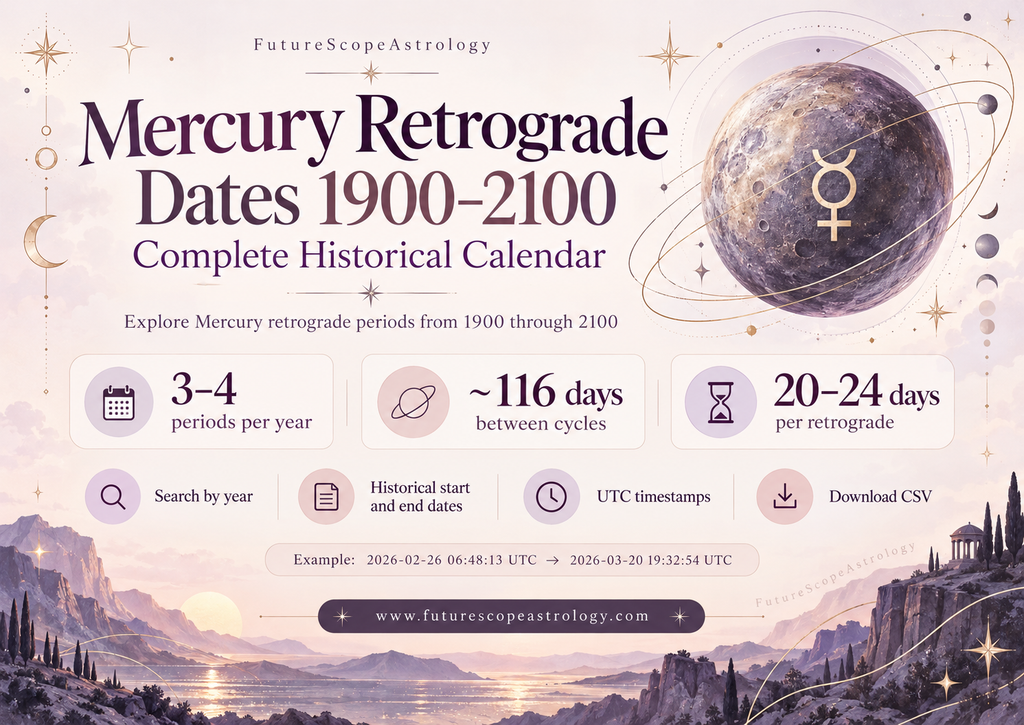
Mercury goes retrograde approximately three to four times each year, with each period lasting about three weeks. The calendar above provides Mercury retrograde start and end dates from 1900 through 2100, allowing you to explore more than two centuries of past and future retrograde cycles.
Select any year to see when Mercury turns retrograde, when it returns to direct motion and how long each retrograde period lasts. Download the results as a CSV file for research, recordkeeping or personal reference.
✦ What Is Mercury Retrograde?
Mercury retrograde occurs when Mercury appears to move backward against the background stars as viewed from Earth.
Mercury does not actually reverse its orbit around the Sun. This apparent backward motion happens because Earth and Mercury travel around the Sun at different speeds. As their relative positions change, Mercury temporarily appears to move in the opposite direction across our sky.
In astrology, Mercury governs themes of communication, thinking, information, travel and technology. Astrologers associate retrograde periods with reviewing decisions, revisiting conversations and checking details carefully. These interpretations are not scientifically established effects of planetary motion.
Read more: What Happens During Mercury Retrograde?.
◷ How Often Does Mercury Go Retrograde?
Mercury typically goes retrograde three or four times per year, with retrograde periods recurring roughly every 116 days. The exact intervals vary, and each period usually lasts around 20 to 24 days.
Mercury experiences several retrograde periods during a year, unlike slower-moving planets such as Jupiter and Saturn. The historical calendar makes it easy to compare these recurring cycles across decades.
◈ How to Read the Historical Calendar
Each entry provides three key measurements:
Retrograde Begins — When Mercury’s apparent movement changes from direct to retrograde.
Direct Again — When Mercury resumes its usual apparent forward motion.
Duration — The length of the retrograde period, expressed in days.
All times are displayed in UTC (Coordinated Universal Time). Depending on your location, the local date may be different.
The calendar covers Mercury retrograde periods beginning from January 1, 1900, through December 31, 2100.
✧ Frequently Asked Questions
Does Mercury retrograde happen on the same dates every year?
No. Mercury retrograde dates change each year because its orbital cycle does not align precisely with Earth’s calendar year.
Can Mercury retrograde continue into the following year?
Yes. A retrograde period can begin in December and end in January.
Does Mercury retrograde affect everyone?
Mercury’s apparent retrograde motion is an astronomical event. Astrological interpretations vary according to an individual’s zodiac sign and birth chart. There is no scientific evidence that retrograde motion causes changes in personal events.
Are Mercury retrograde dates different in Vedic and Western astrology?
The astronomical dates are the same. However, Vedic astrology commonly uses the sidereal zodiac, while Western astrology generally uses the tropical zodiac. Mercury’s zodiac sign placement can therefore differ between the two systems.
Explore the Mercury Transit and Retrograde Dates 1900–2100 for more information.
Can I download historical Mercury retrograde dates?
Yes. Select Download Selected Year CSV for one year’s dates or Download Complete CSV for the full 1900–2100 dataset, including detailed UTC timestamps and FutureScope Astrology attribution.