
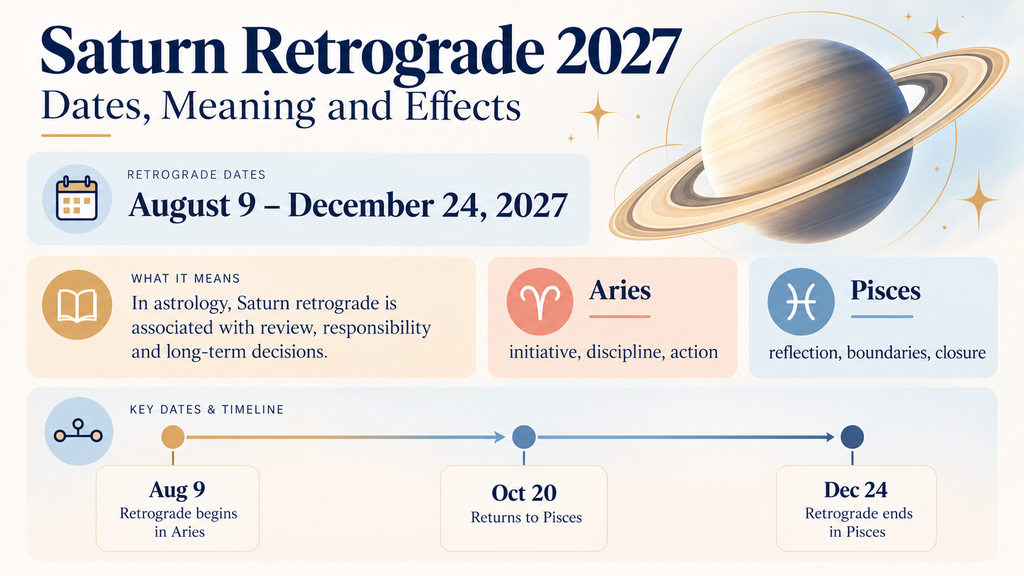
Saturn Retrograde 2027 begins on August 9 and ends on December 24. During this period, Saturn moves backward through Aries and returns to Pisces on October 20.
In Vedic astrology, Saturn (Shani) represents discipline, responsibility, patience and long-term consequences. Its retrograde period is traditionally associated with reviewing commitments, correcting past decisions and reconsidering established plans.
What makes 2027 distinctive is Saturn’s return from Aries to Pisces, bringing two different astrological themes into the same retrograde cycle.
For the complete yearly timeline, see Saturn Transit 2027: Dates, Zodiac Signs and What to Expect.
When Is Saturn Retrograde in 2027?
Saturn remains retrograde for approximately 137 calendar days, beginning in Aries and ending in Pisces.
The key dates are:
What Does Saturn Retrograde Mean?
Saturn retrograde represents reassessment rather than automatic misfortune.
Astrologically, Saturn governs structure, boundaries, duty and persistence. Its retrograde movement is interpreted as a period for examining whether existing responsibilities and long-term plans remain appropriate.
This may involve reviewing career commitments, financial obligations or the balance between personal needs and responsibilities.
For more on its traditional significance, explore Saturn (Shani) in Astrology.
Astronomically, retrograde is an apparent reversal of direction, not a planet changing its orbit. NASA’s explanation of Saturn’s retrograde motion illustrates this effect.
Saturn Retrograde in Aries: August 9 – October 20
Aries represents initiative, independence and action. Saturn represents patience, restraint and responsibility.
In traditional Vedic astrology, Saturn is debilitated in Aries. During retrograde, this combination highlights the tension between acting quickly and working methodically.
The central theme is disciplined initiative.
Read more about the characteristics of Saturn in Aries.
Saturn Retrograde in Pisces: October 20 – December 24
Pisces emphasizes sensitivity, imagination, compassion and personal ideals.
When retrograde Saturn returns to Pisces, the focus shifts toward emotional boundaries, unfinished responsibilities and the practical demands of long-term aspirations.
The central theme is turning reflection into workable decisions.
Explore the traditional interpretation of Saturn in Pisces.
Which Zodiac Signs Are Affected?
All twelve signs are considered in Saturn transit interpretations, but the effects differ according to the individual’s Moon sign, ascendant and natal planetary positions.
Aries and Pisces are especially relevant because Saturn occupies both signs during its 2027 retrograde.
For some Moon signs, Saturn’s movement also forms part of the longer Sade Sati cycle. Learn how its phases are interpreted in Sade Sati: Meaning, Phases and Effects.
You can check your Sade Sati status or consult the Saturn Transit and Retrograde Dates calendar.
Frequently Asked Questions
01 / When Does Saturn Retrograde Start in 2027?
August 9, 2027, with Saturn in Aries.
02 / When Does Saturn Retrograde End?
December 24, 2027, with Saturn in Pisces.
03 / Does Saturn Retrograde Change Zodiac Signs?
Yes. Saturn moves backward from Aries into Pisces on October 20.
04 / Is Saturn Retrograde Always Negative?
No. In traditional astrology, it emphasizes reassessment and responsibility rather than guaranteeing negative outcomes.
Final Thoughts
Saturn Retrograde 2027 moves from initiative toward reflection. Aries highlights disciplined action, while Pisces emphasizes boundaries and unresolved obligations.
The period offers an astrological framework for reviewing long-term commitments and identifying where greater consistency may be needed.