
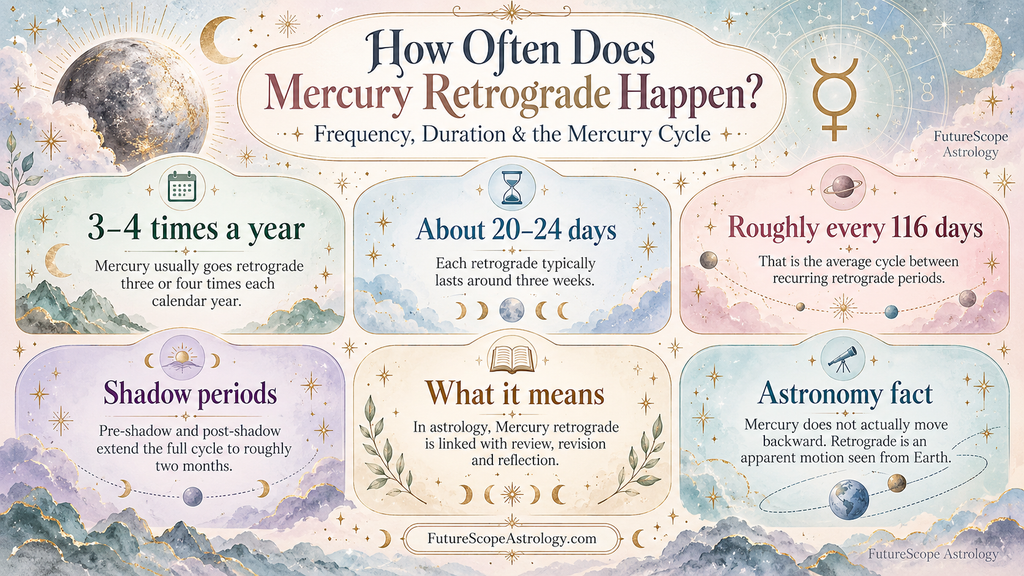
Mercury retrograde occurs three or four times a year, and each retrograde generally lasts about three weeks. The periods recur roughly every 116 days as Mercury and Earth move around the Sun at different speeds.
Although Mercury appears to reverse direction against the background of the zodiac, it never physically travels backward in its orbit. Retrograde motion is an apparent change in direction caused by the changing positions of the planets as viewed from Earth.
Retrograde periods per year
Typical days per retrograde
Days between recurring cycles
Typical retrograde duration
Mercury spends most of the year in apparent direct motion. Its retrograde phases are comparatively short and recur regularly throughout the calendar.
For a historical record of individual start and end dates, explore our Mercury Retrograde Dates 1900–2100 Calendar.
☿ How Often Does Mercury Retrograde Happen?
Mercury usually goes retrograde three times in a calendar year, with some years containing four periods. This pattern comes from the relatively short interval between successive Mercury–Earth alignments.
Mercury is the closest planet to the Sun and completes one orbit much faster than Earth. As the two planets move around the Sun, the viewing angle from Earth changes, periodically creating the appearance that Mercury is moving backward against the stars.
☀️ Why Does Mercury Retrograde Repeat Every 116 Days?
Mercury’s Orbit
Mercury takes approximately 88 Earth days to complete one orbit around the Sun.
Earth’s Orbit
Earth takes approximately 365 days to complete one orbit around the Sun.
Mercury’s Synodic Period
The interval between successive similar alignments of Mercury, Earth and the Sun.
Annual Pattern
Several Mercury retrograde periods fit into one calendar year because the synodic cycle is much shorter than a year.
The synodic period explains why Mercury retrograde repeats regularly. However, the precise dates do not fall at identical intervals because the planets’ orbital speeds and apparent movements are not perfectly uniform.
🌙 Does Mercury Retrograde Happen on the Same Dates Every Year?
No. Mercury retrograde dates shift from year to year.
Because the cycle repeats approximately every 116 days rather than on a fixed monthly or annual calendar, its start and end dates gradually change.
This also explains why some calendar years contain three retrograde periods and others may contain four.
⏳ How Long Does Mercury Retrograde Last?
A typical Mercury retrograde lasts approximately 20 to 24 days. Some individual cycles fall slightly outside this range, depending on Mercury’s apparent motion and the orbital geometry involved.
The period begins when Mercury changes from apparent forward movement to apparent backward movement. It ends when Mercury stations direct and resumes apparent forward motion.
✨ Mercury Retrograde: The Three Main Stages
01 · Pre-Retrograde Shadow
Mercury is direct. It moves forward through the zodiac degrees it will later revisit during retrograde.
02 · Mercury Retrograde
Mercury appears to move backward. This phase typically lasts around three weeks and ends when Mercury stations direct.
03 · Post-Retrograde Shadow
Mercury is direct again. It moves forward across the same zodiac degrees until it passes the point where retrograde began.
The shadow periods generally extend for around two to three weeks on either side of the retrograde, although their lengths vary. The complete cycle, including both shadows, may therefore span roughly two months.
Read our Mercury Retrograde Shadow Period Guide for a detailed explanation of how these dates are calculated.
✦ Is Mercury Retrograde for Three Weeks or Two Months?
Both descriptions refer to different parts of the cycle.
Three weeks describes the typical retrograde phase, when Mercury appears to move backward.
Roughly two months describes the broader sequence when the pre-shadow and post-shadow periods are also included.
Mercury is not retrograde throughout the complete shadow cycle. It is moving direct during both shadow phases.
🌸 Why Is Mercury Retrograde More Frequent Than Other Planetary Retrogrades?
Mercury’s short orbital period creates frequent changes in its apparent position relative to Earth. Its synodic cycle is approximately 116 days, resulting in several retrograde periods each year.
Other planets have different orbital periods and Earth-relative viewing geometries, so their apparent retrograde patterns differ.
The astronomical mechanism is the same general principle: a planet’s apparent position against the background stars changes as Earth and the other planet move along their orbits.
✨ What Does Mercury Retrograde Mean in Astrology?
In Western astrology, Mercury traditionally represents communication, learning, information, reasoning, commerce and movement.
Its retrograde phases are interpreted as periods for reviewing assumptions, revisiting unfinished matters and examining decisions more carefully.
💬 Communication
Revisit conversations, clarify expectations and check whether important information has been understood.
📋 Decisions
Review the details behind agreements and reconsider earlier choices when new evidence is available.
💻 Technology
Maintain backups, verify information and resolve genuine technical problems using their actual causes.
🌿 Personal Reflection
Return to unfinished work, reassess priorities and make constructive revisions where necessary.
These are traditional astrological interpretations. There is no scientific evidence that Mercury’s apparent retrograde motion causes communication failures, travel disruptions or personal difficulties.
🌍 Is Mercury Retrograde Different in Western and Vedic Astrology?
The astronomical phenomenon occurs at the same moment worldwide. Mercury’s apparent backward motion does not depend on which astrological system is being used.
However, Western astrology generally uses the tropical zodiac, while Vedic astrology commonly uses the sidereal zodiac. As a result, the zodiac sign assigned to Mercury during a retrograde may differ between the two systems.
The underlying retrograde event remains the same.
🔭 How Can You Check If Mercury Is Retrograde?
You can check Mercury’s current apparent direction and upcoming changes using our Is Mercury Retrograde Right Now? tool.
For a longer perspective, our historical calendar lets you explore retrograde periods across more than two centuries without relying on individual yearly articles.
❓ Mercury Retrograde Frequency and Duration: FAQs
How many times a year does Mercury retrograde happen?
Mercury retrograde usually occurs three or four times per calendar year.
How long is Mercury retrograde?
Each period typically lasts approximately 20–24 days, or around three weeks.
How many days apart are Mercury retrogrades?
The recurring cycle is approximately 116 days, although the exact intervals between stations can vary.
Does Mercury retrograde happen every month?
No. Mercury retrograde occurs several times per year, not every month.
Why does Mercury retrograde happen so often?
Mercury orbits the Sun much faster than Earth. Their changing relative positions create an apparent retrograde cycle roughly every 116 days.
Does Mercury actually move backward?
No. Mercury continues orbiting the Sun in its normal direction. Retrograde describes its apparent movement against the stars as seen from Earth.
How long does the Mercury retrograde shadow period last?
The pre-shadow and post-shadow periods often last around two to three weeks each, but the exact duration varies. The full cycle can extend across roughly two months.
When is the next Mercury retrograde?
Mercury’s next retrograde depends on the current date. Use our current-status calculator or historical calendar for the relevant start and end dates.
Is Mercury retrograde the same in Vedic astrology?
The retrograde motion is the same astronomical event. Western and Vedic astrologers may assign it to different zodiac signs because their zodiac reference systems differ.
✦ The Key Takeaway
Mercury retrograde happens three or four times per year, repeats roughly every 116 days and typically lasts around three weeks.
The apparent reversal is caused by the changing positions of Mercury and Earth as they orbit the Sun. Mercury itself never reverses its orbital direction.
Astrology traditionally associates these recurring periods with reflection, revision and communication. The astronomical pattern is measurable, while its proposed influence on everyday life remains an astrological interpretation rather than an established scientific effect.
A regular astronomical pattern, with traditional astrological meanings centred on review and reflection.
✨ Explore More Mercury Retrograde Resources
Mercury Retrograde Dates 1900–2100
Search historical and future retrograde periods by year, including start dates, end dates and durations.
Is Mercury Retrograde Right Now?
Check Mercury’s current retrograde status and upcoming transitions.
Mercury Retrograde Shadow Period
Understand the pre-shadow, retrograde and post-shadow phases.
What Happens During Mercury Retrograde?
Learn about apparent retrograde motion and its traditional interpretation.
Was Mercury Retrograde When I Was Born?
Use our birth-date calculator to check Mercury’s direction at the time of your birth.